Newton’s Laws of Motion
Understanding the core laws is the foundation for solving mechanics problems.
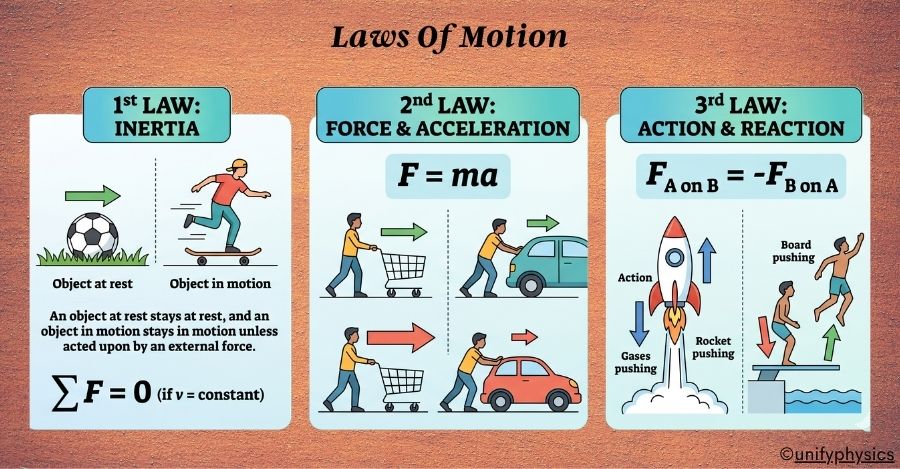
- First Law (Law of Inertia): A body continues in its state of rest or uniform motion in a straight line unless acted upon by an external force.
- Second Law (Real Law of Motion): The rate of change of momentum is directly proportional to the applied force.
- Formula: \(\displaystyle \vec{F} = \frac{d\vec{p}}{dt} = m\vec{a}\).
- For a System of Particles: \(\displaystyle \vec{F}_{ext} = m_1\vec{a}_1 + m_2\vec{a}_2 + m_3\vec{a}_3 …\).
- Third Law (Action-Reaction): To every action, there is an equal and opposite reaction.
- Formula: \(\displaystyle \vec{F}{AB} = -\vec{F}{BA}\).
Momentum & Impulse
These concepts are highly tested in collision and impact questions.
| Quantity | Formula | NEET Explanation & Key Insights |
| Linear Momentum (\(\displaystyle \vec{p}\)) | \(\displaystyle \vec{p} = m\vec{v}\) | The quantity of motion contained in a body. |
| Conservation of Momentum | If \(\displaystyle F_{ext} = 0\), then \(\displaystyle \vec{p} = \text{constant}\) | If no external force acts on an isolated system, its total momentum remains conserved. |
| Recoil of Gun | \(\displaystyle v = -\frac{mu}{M}\) | Where m, u are mass and velocity of bullet, and M, v are mass and velocity of the gun. The negative sign shows the gun recoils in the opposite direction. |
| Impulse (\(\displaystyle \vec{J}\)) | \(\displaystyle \vec{J} = \int \vec{F} dt = \Delta\vec{p}\) | Impulse is the product of force and time, equaling the total change in momentum. Non-impulsive forces (like gravity or spring force) cannot balance impulsive forces (like a hammer blow). |
Standard Mechanical Systems & Shortcuts
Save time in the exam by memorizing these standard system results.
Pulley System (Atwood Machine)
A. Pulley System (Atwood Machine) For two masses (\(\displaystyle m_1\) and \(\displaystyle m_2\), where \(\displaystyle m_2 > m_1\)) connected by a string over a frictionless pulley:
- Acceleration of system: \(\displaystyle a = \left( \frac{m_2 – m_1}{m_1 + m_2} \right)g\).
- Tension in string: \(\displaystyle T = \frac{2m_1m_2}{m_1 + m_2}g\).
Spring Force & Combinations
B. Spring Force & Combinations
- Restoring Force: \(\displaystyle F = -kx\) (where k is the spring constant and x is displacement).
- Spring Cutting Trick: The product of spring constant and natural length is always constant (\(\displaystyle k \times l = \text{constant}\)).
- Shortcut: If a spring is cut into two parts in the ratio $m:n$, the new spring constants are \(\displaystyle k_1 = \left( \frac{m+n}{m} \right)k\) and \(\displaystyle k_2 = \left( \frac{m+n}{n} \right)k\).
- Series Combination: \(\displaystyle \frac{1}{k_{eq}} = \frac{1}{k_1} + \frac{1}{k_2} + …\).
- Parallel Combination: \(\displaystyle k_{eq} = k_1 + k_2 + …\).
Pseudo Force (Non-Inertial Frames)
C. Pseudo Force (Non-Inertial Frames) When solving a problem from the perspective of an accelerating frame (like a moving car or elevator):
- Formula: \(\displaystyle \vec{F}{pseudo} = -m\vec{a}{frame}\).
- Explanation: Apply this fictitious force in the direction opposite to the frame’s acceleration, and then use Newton’s laws as if the frame were at rest. Note that a weighing machine measures the normal force exerted by the object, not its true weight.
Friction
Friction opposes relative motion between two surfaces in contact.
- Static Friction (\(\displaystyle f_s\)): It is a variable, self-adjusting force that prevents relative motion.
- Range: \(\displaystyle 0 \le f_s \le f_{s(max)}\).
- Limiting (Maximum) Static Friction: \(\displaystyle f_{s(max)} = \mu_s N\) (where \(\displaystyle \mu_s\) is the coefficient of static friction and N is normal reaction).
- Kinetic Friction (\(\displaystyle f_k\)): The constant friction acting when the body is actually sliding.
- Formula: \(\displaystyle f_k = \mu_k N\).
Dynamics of Circular Motion
In circular motion, forces must be analyzed carefully along the radial (towards center) and tangential directions.
| Concept | Formula | Key Points |
| Centripetal Force (\(\displaystyle F_c\)) | \(\displaystyle F_c = \frac{mv^2}{r} = m\omega^2 r\) | The real force directed towards the center required to maintain circular motion. |
| Centrifugal Force | \(\displaystyle F = \frac{mv^2}{r}\) (Outwards) | A pseudo force experienced only by an observer inside the rotating frame, acting away from the center. |
| Bending of Cyclist | \(\displaystyle \tan\theta = \frac{v^2}{rg}\) | Angle \(\displaystyle\theta\) made with the vertical to safely negotiate a curve. |
| Banking of Roads (No Friction) | \(\displaystyle \tan\theta = \frac{v^2}{rg}\) | The angle \(\displaystyle\theta\) the outer edge of a road is raised above the inner edge. |
| Safe Speed on Banked Road (With Friction) | \(\displaystyle v_{max} = \sqrt{rg \left[ \frac{\mu + \tan\theta}{1 – \mu\tan\theta} \right]}\) | Gives the maximum safe speed to avoid skidding outwards. (For minimum speed without sliding down, swap the signs of \(\displaystyle\mu\)). |
| Motion in a Vertical Circle | \(\displaystyle v_{min, \text{bottom}} = \sqrt{5gr}\) \(\displaystyle v_{min, \text{top}} = \sqrt{gr}\) | Minimum speeds required to successfully complete a vertical loop. |
| Conical Pendulum | \(\displaystyle T = 2\pi \sqrt{\frac{l\cos\theta}{g}}\) | Time period of a mass m tied to a string of length l rotating in a horizontal circle. |
If two objects are in contact and moving, their velocity components along the direction perpendicular to the contact plane must be exactly equal (assuming no deformation or loss of contact).
Also Read: Motion in a Straight Line / Plane